Apple revealed the iPhone Duo on September 9, 2026.
Then the rest of the internet began revealing what the launch would mean.
Within hours, Samsung, Duolingo, Motorola, Durex and Amul had entered the conversation. Samsung reached for competitive history: "Let us know when you're done reheating our leftovers." Duolingo went for the product's most obvious visual association: "they named a phone after me and made it bend over."
The contrast was almost too neat.
Apple had spent years developing the device, refining its hinge and building a launch designed to command global attention. Its rivals and adjacent brands needed only a social account, a quick read of the room and permission to post.
Apple created the event. Other brands competed to define it.
The launch did not guarantee ownership of the story
The default assumption behind a major product reveal is that investment buys narrative control.
The company owns the stage, the footage, the specifications and the first wave of press coverage. It decides when the product is revealed and which details appear in the keynote. If the launch is large enough, it can appear to own the entire day.
That assumption confuses creating attention with controlling it.
Apple could guarantee that millions of people would look in the same direction. It could not guarantee what they would say once they did.
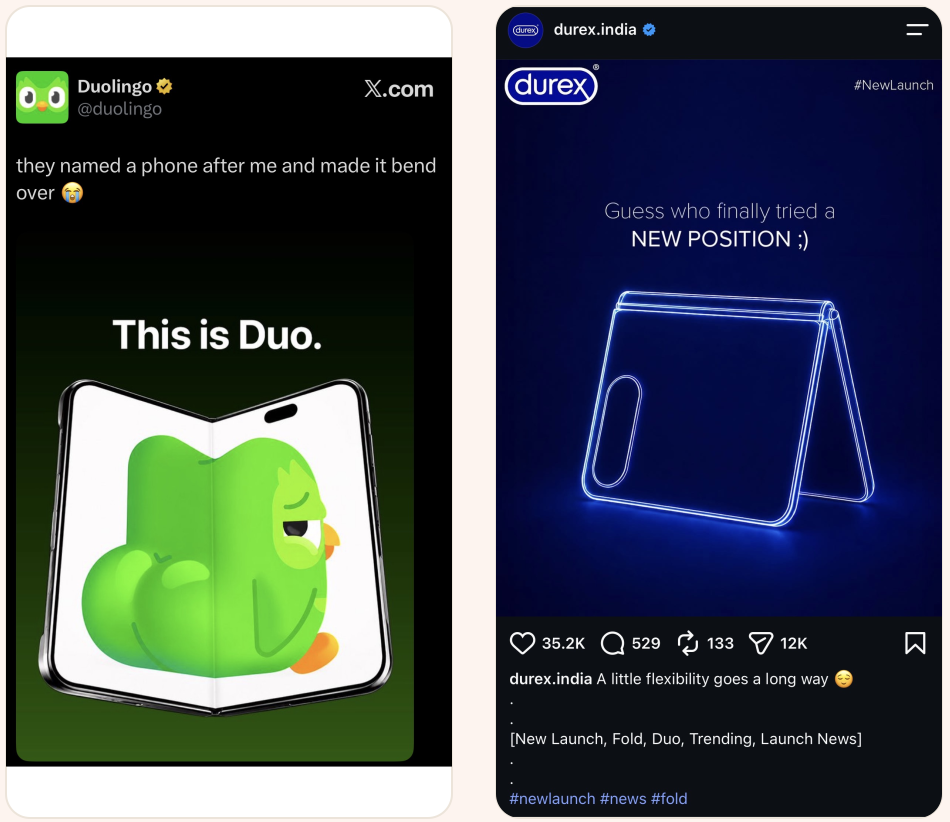
The audience saw the device. The brands saw the opening.
Across social feeds, responses to the iPhone Duo quickly became part of the launch-day spectacle. That does not prove that jokes received a greater share of conversation than product coverage; making that claim would require real social-listening data. But the visibility of those responses still matters.
Samsung and Duolingo did not need to manufacture an audience from scratch. Apple had already assembled one. Their task was to arrive with a sharper interpretation while that audience was paying attention.
This is the asymmetry at the heart of reactive marketing: one company pays to create the moment, while another borrows its distribution by reacting well.
Bendgate already showed us the pattern
The iPhone Duo reaction cycle felt new because of its speed and scale, not because the underlying tactic was new.
In 2014, reports that the iPhone 6 Plus could bend under pressure produced "Bendgate." Rival manufacturers, including Samsung and LG, used the moment to promote the perceived durability or design advantages of their own devices.
The product story escaped Apple's control almost immediately. Engineering became raw material for jokes, comparisons and competitor positioning.
More than a decade later, the basic dynamic remains intact. What has changed is the number of brands equipped to participate, and how quickly they can do it.
A competitor no longer needs a polished response campaign ready for release days later. Nor does a brand need to belong to the same product category. A language-learning app, a condom brand and a dairy brand can all join a hardware launch if each has a voice flexible enough to translate the moment for its own audience.
The opening is wider, but it also closes faster. Once the joke has circulated, the second wave of brand responses feels derivative. The value belongs disproportionately to the brands that recognize the opening first.
The real advantage is decision latency
Reactive marketing is often described as cleverness.
That explanation is incomplete. Plenty of teams contain funny, culturally aware people. Far fewer have built an organization that allows those people to act before the moment expires.
The real capability is low decision latency: the time between noticing an opportunity and publishing a response.
That depends on more than having a witty community manager. It requires a recognizable brand voice, clear boundaries and short approval chains. Someone needs to know what the brand would plausibly say, what it would never say and how much risk the team is permitted to take without convening a committee.
Duolingo's line worked because its voice was already loose enough to make the joke believable. A brand cannot spend years communicating like a legal memo and suddenly borrow internet fluency for one launch day.
Speed without an established voice looks desperate. Voice without decision rights arrives tomorrow.
The brands that consistently perform well in live moments tend to have both: a public personality that creates room to improvise and an internal system that lets them use it.
That is why reaction speed should be treated as a competitive capability, not an accidental burst of personality.
Attention is not the same as conversion
There is an obvious danger in overstating what a successful reaction achieves.
A joke does not prove that Samsung makes the better folding device. It does not answer questions about Apple's hinge, software, durability or price. It does not tell us whether someone who laughed at Duolingo's post will buy an iPhone Duo.
Product truth still matters when the customer reaches the showroom, watches a detailed review or decides whether the device deserves a place in their life.
Reactive content operates at a different layer. It influences distribution and interpretation. It can determine which comparison enters the buyer's mind first, which phrase becomes attached to the launch and which brands remain visible around a cultural event they did not pay to create.
That is valuable, but it is not the same as demand, preference or sales.
The honest claim is narrower: reactive marketing can win a disproportionate share of attention at a fraction of the production cost. It cannot compensate indefinitely for an inferior product.
Fast decision rights deserve a real budget
Marketing teams often resource planned production while treating reactive work as improvisation around the edges.
They budget for campaign shoots, media placement and launch calendars. Then, when a live moment appears, they expect someone on the social team to produce a culturally precise response, secure approval and publish it before the window closes.
That is not a process. It is a gamble.
If reaction speed has distribution value, the ability to move quickly needs deliberate protection. Teams need pre-agreed boundaries, named decision-makers and a voice developed before it is tested in public. They need to decide which risks can be taken quickly and which genuinely require escalation.
None of that means every trend deserves a response. Speed without judgment produces noise. The capability lies in being able to decide quickly, including deciding to stay silent.
Apple owned the product, the keynote and the reason everyone was watching on September 9.
It did not own what the moment became.
That part belonged to the brands ready to react.